
On-Device vs Cloud AI for Mobile Features: Decision Framework
A pragmatic architecture framework for evaluating on-device Core ML models versus cloud LLMs, balancing latency, privacy, thermal budgets, and unit economics.
Whenever a product manager or executive proposes a new AI feature for an iOS app, the discussion almost immediately gets bogged down in a binary debate:
“Should we run this locally on the device with Core ML for privacy, or send it to a massive cloud LLM for better reasoning?”
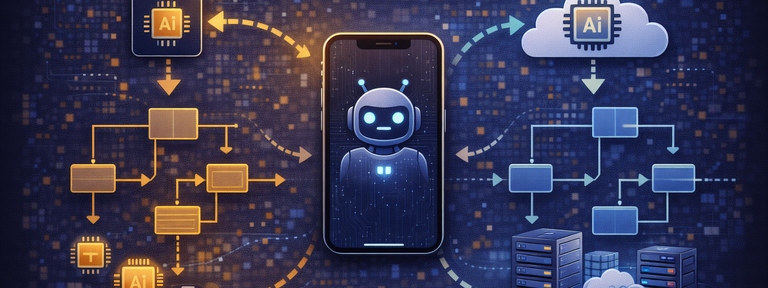
Framing AI architecture as an either/or choice between local and cloud execution is a false dichotomy. In production mobile engineering, the most resilient, cost-effective, and responsive architectures are hybrid cascading systems that use on-device compute for fast feedback and selectively escalate complex tasks to the cloud.
Here is the decision framework and architectural blueprint I use to evaluate model placement in iOS apps.
The Four Core Trade-off Dimensions
To make an objective technical choice, map your proposed feature against four fundamental constraints:
┌───────────────────────┬──────────────────────────┬──────────────────────────┐
│ Dimension             │ On-Device (Core ML / ANE)│ Cloud LLM (Server API)   │
├───────────────────────┼──────────────────────────┼──────────────────────────┤
│ 1. Interaction Latency│ Ultra-fast (10ms - 80ms) │ High (600ms - 4000ms)    │
│ 2. Privacy & Data Law │ Zero data leaves device  │ Requires network payload │
│ 3. Compute Unit Cost  │ Free (client hardware)   │ Linear token cost ($/req)│
│ 4. Reasoning & Depth  │ Specialized / 4-bit quantized Heavier reasoning & world│
│                       │ tasks (classification)   │ knowledge                │
└───────────────────────┴──────────────────────────┴──────────────────────────┘
1. Latency & Interactive Feedback Loops
If a feature is directly tied to the user’s keystrokes, gestures, or camera feed (such as real-time search filtering, text token prediction, or live image segmentation), cloud execution is fundamentally unsuitable.
Network round-trips introduce jitter, cellular handshake overhead, and cold starts. Even a 500ms network delay feels like a frozen interface when a user is actively typing.
Rule of thumb: Any interaction that occurs while the user is actively typing or dragging requires local, on-device processing via the Apple Neural Engine (ANE).
2. Privacy Boundaries and Zero-Knowledge Design
For applications handling sensitive user data (such as health records, private journals, financial transactions, or photos), sending unencrypted raw text to third-party cloud APIs introduces immense compliance risks and erodes user trust.
On-device processing provides an airtight privacy guarantee: the user’s raw data never touches external network cables. When cloud processing is strictly necessary for large-scale synthesis, implement client-side redaction and token anonymization before dispatching payloads over TLS.
3. App Bundle Size, Memory, and Thermal Budgets
While modern iPhones pack impressive neural processing power, mobile devices are constrained by physics:
- RAM Limits: An iOS app that consumes more than 1.5 GB of memory risks being immediately terminated by the operating system’s Jetsam memory watchdog.
- Thermal Throttling: Running a 3-billion-parameter local model continuously will warm the chassis and cause iOS to throttle CPU frequencies.
- App Store Download Limits: Including massive weights inside the app bundle forces users onto Wi-Fi downloads.
For on-device models, we strictly limit models to quantized 4-bit weights under 150 MB, downloaded on-demand via Background Assets or On-Demand Resources (ODR).
4. The Cascading Hybrid Architecture Pattern
Instead of choosing one extreme, our team standardizes on a Cascading Hybrid Router.
When a user triggers an action:
- Tier 1 (Instant Local Heuristic): A lightweight on-device Core ML model or embedding classifier attempts to resolve the intent immediately.
- Tier 2 (Confidence Evaluation): If the local model resolves the query with high confidence (> 0.85), return the result in under 30 milliseconds.
- Tier 3 (Cloud Escalation): If the local model signals ambiguity or the task requires broad general knowledge, escalate the query to the cloud backend with explicit streaming feedback to the user.
[User Action / Input]
         │
         ▼
[Tier 1: On-Device Core ML (10ms)] ──(High Confidence > 0.85)──► [Instant Render (<30ms)]
         │
         ▼ (Low Confidence or Complex Intent)
[Tier 2: Cloud Gateway Routing] ────► [Streaming Response to UI (600ms)]
         │
         ▼ (Network Timeout / Failure)
[Tier 3: Local Deterministic Fallback]
This three-tier pipeline gives you the best of both worlds:
- Instant baseline speed: High-frequency, repetitive queries resolve entirely on the Apple Neural Engine in under 30 milliseconds with zero server cost and zero privacy risk.
- Deep cloud capabilities: Rare, complex reasoning tasks are escalated to specialized backend models with explicit streaming feedback to the user.
- Resilient offline behavior: If the device loses cellular connectivity in a parking garage or subway, the local fallback ensures the core application remains fully functional.
Summary
The best mobile AI features feel invisible. They respond instantly, preserve battery life, respect user privacy, and degrade gracefully when the device is in airplane mode.
By building a cascading hybrid pipeline, you harness the raw horsepower of the Apple Neural Engine for daily speed, while reserving expensive cloud LLM calls for the rare tasks that genuinely demand deep reasoning.