
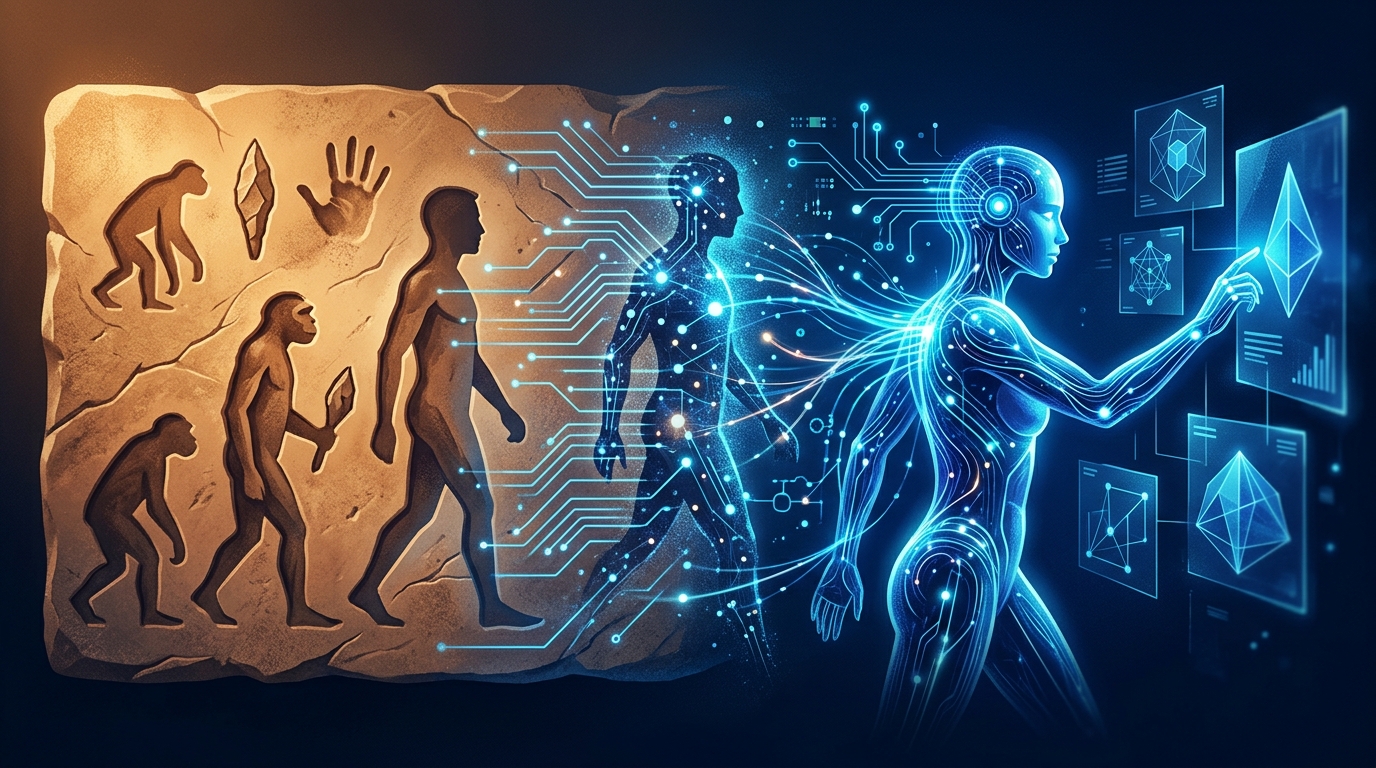
Reading Notes 2025: Sapiens and AI Product Thinking
How revisiting Yuval Noah Harari's Sapiens altered my mental model for designing AI-enabled software, building user trust, and navigating technical uncertainty.
When I picked up Yuval Noah Harari’s Sapiens: A Brief History of Humankind again in early 2025, I did not expect it to become a field manual for product architecture. At the time, our engineering team was deep in the weeds of shipping generative AI features and autonomous agents into our apps. We were debating token latency, model context windows, and fallback schemas.
Yet the deeper I got into Harari’s breakdown of the Cognitive Revolution, the Agricultural Revolution, and the Scientific Revolution, the more I realized that our industry’s technical obsession was missing the forest for the trees.
The central thesis of Sapiens is that humans dominate the planet because we are the only animals capable of cooperating flexibly in large numbers based on shared fictions (stories, laws, currencies, and imagined orders).
Applying that historical lens to modern software engineering, especially in the era of probabilistic models, completely reshaped how I think about user experience, system design, and engineering leadership.
1. The Myth of the Autonomous Tool
In Sapiens, Harari demonstrates that tools never exist in a vacuum; they reshape the social fabric and behavioral expectations of the humans who adopt them. When hunter-gatherers transitioned to agriculture during the Agricultural Revolution, they thought they were making their lives easier by securing food. In reality, they worked longer hours, experienced more disease, and became bound to the land. As Harari puts it, humanity did not domesticate wheat; wheat domesticated humanity.
In software engineering today, we risk falling into a similar trap with generative AI.
We convince ourselves that adding an AI chatbot or autocomplete engine into an application is purely an additive convenience. But in practice, probabilistic features completely rewrite the user’s mental contract with the software:
- In deterministic software, a button click either succeeds or returns an explicit error code. The mental model is mechanical and predictable.
- In AI-driven software, the system produces probabilistic guesses. If the interface does not communicate uncertainty clearly, users either over-rely on the system (and get burned by hallucinations) or reject it entirely after the first failure.
When designing AI features now, I always ask: What implicit bargain are we asking the user to make? Does this feature actually save cognitive effort, or does it simply shift their workload into verification and editing?
2. Shared Narratives Build User Trust
One of the strongest arguments in Sapiens is that money and institutions function only because millions of people share a mutual belief in their value. Trust is an invisible network effect.
In mobile and AI product design, trust behaves the exact same way. If a user encounters an AI feature that acts like a black box (making changes without showing its reasoning or offering an undo stack), that shared trust collapses instantly.
To build durable user trust in our applications, we instituted three core interface principles:
- Never hide the seams: Distinguish clearly between deterministic data retrieved from our database and probabilistic suggestions generated by a model. Users should never have to guess whether a value is verified truth or an algorithmic prediction.
- First-class undoability: Any action proposed or drafted by an AI system must be reversible in a single tap without destructive side effects. A user will explore ambitious features only if the cost of rolling back a mistake is near zero.
- Transparent confidence levels: When the model has low confidence in a structured output, degrade gracefully into an editable draft or traditional form instead of faking certainty. Silent failure destroys trust; honest uncertainty preserves it.
3. Short-Term Convenience vs Long-Term Systems
Another striking lesson from the book is how technological transitions often solve immediate discomfort while creating massive downstream debt.
In engineering leadership, the AI hype cycle exerts relentless pressure to ship features for the sake of demo videos. But if those features increase maintenance surface area without solving a core user problem, they become organizational debt.
Whenever our team evaluates a new AI feature proposal, we run it through three filters inspired by systems thinking:
- The Recovery Test: If the external model provider experiences a 20-minute outage or returns garbage JSON, does our core app still work for the user?
- The Correction Tax: How many clicks or keystrokes does it take a user to fix an incorrect AI output compared to entering the data manually from scratch?
- The Cognitive Burden: Does this feature make the user feel empowered and in control of their workflow, or does it make them feel anxious about checking the machine’s homework?
Summary
Rereading Sapiens in 2025 reminded me that engineering is fundamentally a human endeavor. Technology will continue to accelerate, models will get faster, and context windows will expand. But the underlying principles of human collaboration, trust, and mental models remain constant.
The engineering teams that win in the long run will not be the ones that haphazardly sprinkle AI across every screen. They will be the teams that deeply understand human behavior, build transparent systems, and earn the enduring trust of their users.