
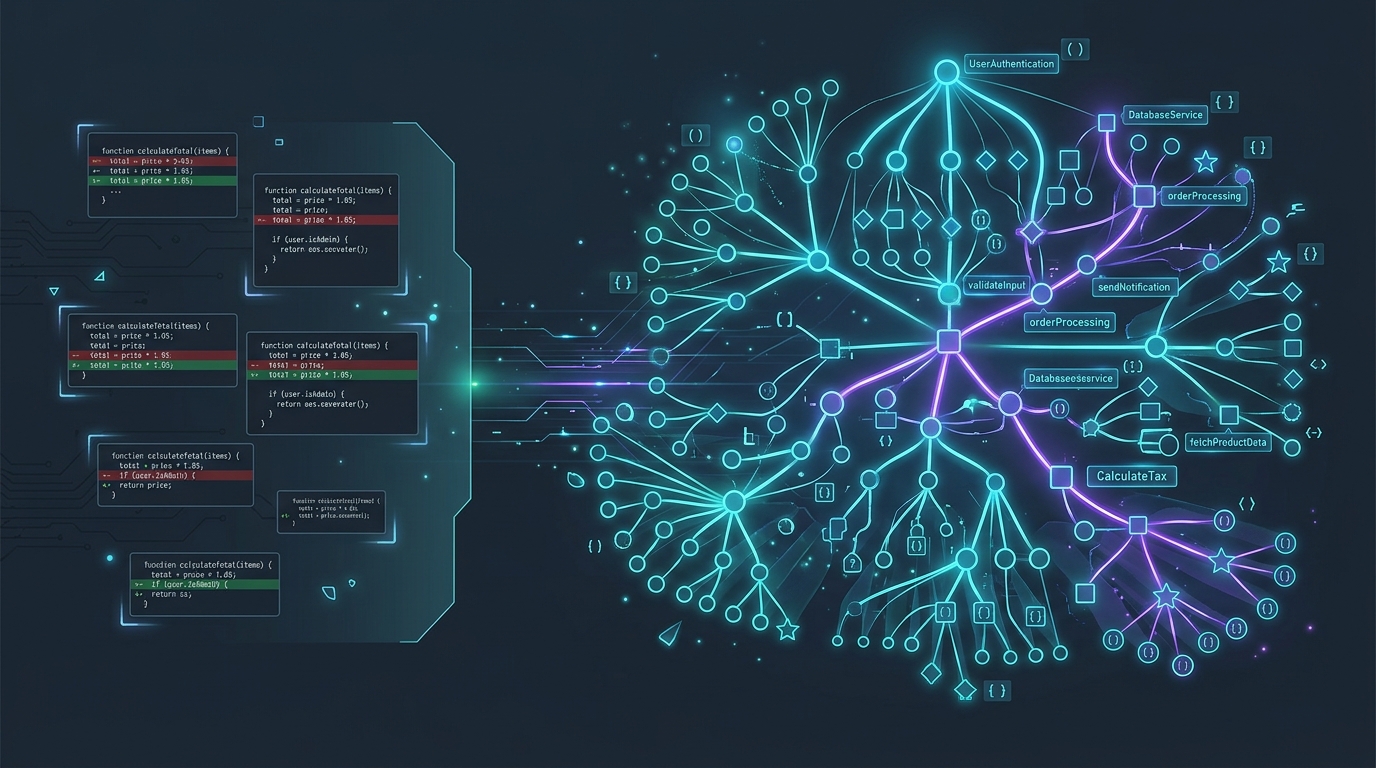
Why AI Code Reviews Are Broken (And How Structural Graphs Fix Them)
Most AI code review tools only look at the PR diff, missing crucial architectural dependencies and callers. Here is why structural codebase graphs change the game.
If you’ve enabled an AI bot to review pull requests in your GitHub or GitLab repository over the last year, you’ve almost certainly experienced the shallow review syndrome.
The bot leaves comments like:
- “Consider adding a docstring here.”
- “Variable
tempcould have a more descriptive name.” - “Looks good to me! Clean code.”
Meanwhile, the pull request quietly renamed an internal enum case that broke three background sync jobs in unedited files, bypassed an authentication interceptor, and left two unit tests completely out of date.
The AI didn’t miss these issues because LLMs are bad at logic. It missed them because it was only shown the diff.
The Fundamental Flaw: The Diff Illusion
In software engineering, changed lines are only the tip of the iceberg. The real complexity of any system lives in its edges: the relationships between functions, callers, protocol conformances, database models, and test suites.
flowchart TD
    subgraph IsolatedDiff["What the AI Bot Sees: Isolated Diff"]
        direction TB
        DiffNode["PaymentService.swift (Changed Lines)"]:::danger
    end

    subgraph DependencyGraph["What Actually Exists: Full Dependency Graph"]
        direction TB
        SourceNode["PaymentService.swift (Changed)"]:::danger
        SourceNode --> WorkerNode["OrderProcessingWorker.swift"]:::info
        SourceNode --> AnalyticsNode["AnalyticsEngine.swift"]:::info
        SourceNode --> TestsNode["PaymentServiceTests.swift"]:::success
        AnalyticsNode --> SyncNode["CloudSyncPipeline.swift"]:::primary
    end

    IsolatedDiff -. "Context Gap" .-> DependencyGraph

    style IsolatedDiff stroke:#ef4444,stroke-width:2px
    style DependencyGraph stroke:#22c55e,stroke-width:2px
When you prompt an AI with only git diff main...HEAD, you are forcing the model to make architectural judgments with 95% of the system context obscured.
Enter the Code Review Graph
To give AI models genuine architectural depth, we have to feed them a structural knowledge graph of the repository before they inspect the changed lines.
A Code Review Graph indexes your repository locally into nodes (files, classes, functions, structs, types) and edges (imports, calls, overrides, references). When a pull request is created, the system calculates:
- The Direct Callers: What other components actually execute this modified function?
- The Blast Radius: How far through the dependency tree do these changes propagate?
- The Test Coverage Delta: Are the existing tests exercising the modified codepath, or are downstream callers now untested?
- Architectural Community Boundaries: Did a UI island just import a low-level database internal that violates layering rules?
// Conceptual: Graph-informed context retrieval for LLM review
interface ReviewContext {
  changedFiles: string[];
  affectedCallers: Node[];
  blastRadiusScore: number;
  untestedDownstreamNodes: Node[];
  architecturalViolations: BoundaryAlert[];
}
Real-World Impact: What Changes in Daily Practice
When you connect an MCP (Model Context Protocol) graph server to assistants like Claude Code, Cursor, or Gemini CLI, the quality of code review shifts dramatically:
1. Catching Silent Contract Breaks
Instead of nitpicking indentation, the assistant alerts you:
“Modifying
fetchUserProfile()to return an optional profile breaksUserProfileHeaderView.swift:L42, which expects a non-null instance without fallback handling.”
2. Identifying Missing Tests
Instead of assuming tests pass because CI is green, the assistant points out:
“The logic branch in
OrderValidator.swift:L88was added, butOrderValidatorTests.swifthas no assertions for invalid currency codes.”
3. Preventing Architectural Drift
In large codebases, teams establish module boundaries for a reason. Graph-aware reviews flag when a feature branch accidentally introduces circular dependencies or bypasses repository abstractions.
Summary: Better Context Beats Bigger Models
For the past three years, the industry’s default response to AI mistakes was “wait for the next frontier model.”
While models have certainly improved, raw model intelligence cannot compensate for missing information. If you don’t show the model the callers, the model cannot evaluate the callers.
The future of high-signal AI code review is not about longer generic prompts. It is about giving AI the exact structural graph of your architecture before it writes a single word.